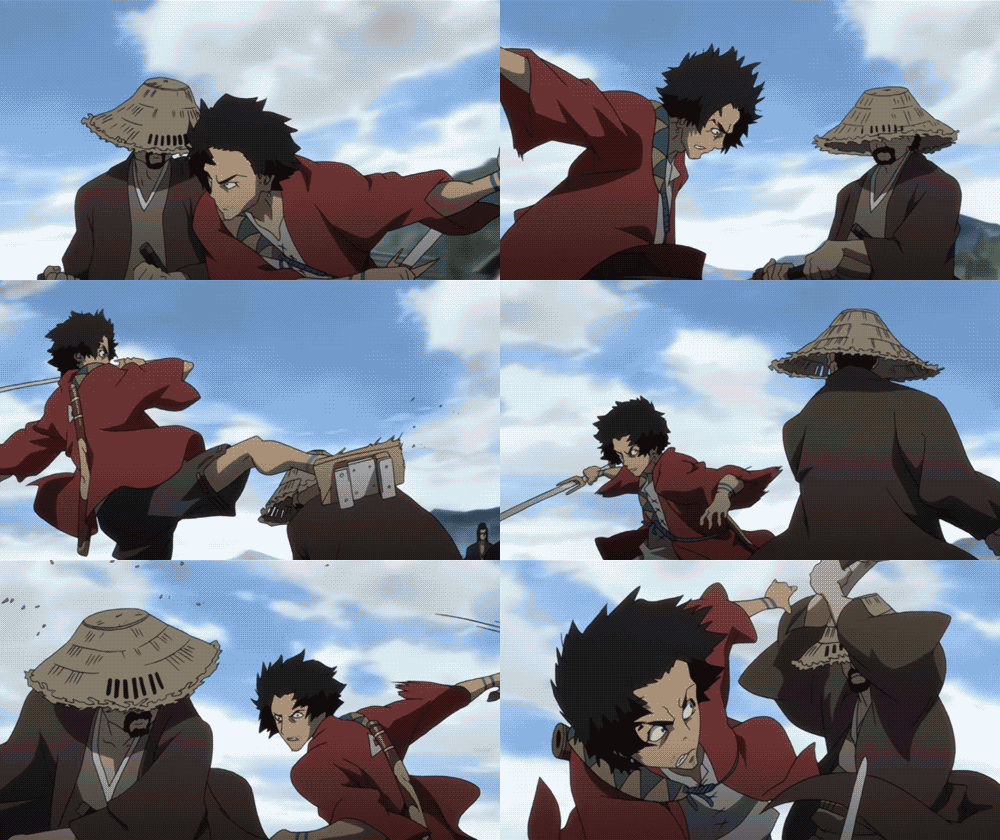
So, you've finally joined that Battle Royale Samurai Ninja Mecha Warrior Magical Girl roleplay that everyone has been raving about. Unfortunately, you have no idea how to roleplay a fight scene. Or maybe you do, but they just come out looking dry and uninspired.
So here are the mechanics of fight scenes and make your writing go from 0 to 100!
Let's begin!
Communication is Key

"Roger roger!"
"Roger roger!"
"MEGAN MEGAN!"
"... that's not how this works..."
I've said it in other posts, and I'll say it again: communication is key! If you're the note taking sort, add this to the top in bold letters and underlined in red.
You must always be in communication with the players you are roleplaying with. Wether it's a chat box, skype, discord, a pigeon: get talking with them. Even if you've never really talked with them before or otherwise engaged with them, that doesn't mean you can slack off now.
It's important to discuss with the other player what it is you intend to do in the fight scene. You don't have to be super explicit (ie: I'm going to punch you, then go for your stomach. Then I shall slit your throat with a dagger I have hidden.) But at least keep them aware that you may be doing things they are not cool with. (ie: Hey, is it okay if my character wins the fight?) More will be explained in detail in the following points.
Gauging Your Power Level

Weakness? Weakness is for peasants!
Whether you are fighting another player, some random NPCs, or even a character/NPC that you control yourself, it is important to be aware of how the different characters stack up to each other.
There are few things more annoying in a roleplay like a "totally awesome epic fighter who can like totally take on fifty guys without breaking a sweat". We call these people OP, or over-powered. OP characters aren't necessarily derogatory (ie: the goddess of a fantasy world would be considered OP compared to a mortal peasant), but what I am referring to specifically are those characters that are OP for literally no reason.
They're just untouchable, flawless, absolute power and perfection. Again, for no reason. This is extremely unrealistic. In the words of the wise Qui-Gon Jin "There's always a bigger fish". Whether you like it or not, there are going to be people out there more powerful than you, and it should reflect in your characters when you face up against someone.
So rather than take out fifty guys without breaking a sweat, how about taking out twenty fairly easy but then suffer some damage and fatigue with the last thirty.
Taking damage is not mandatory, but showing actual effort and overcoming the odds will make your character more realistic, relatable, and not seem like some overhyped douche canoe.
Now that doesn't mean your character cannot be a good fighter. There are times where someone in real life manages to take out a bunch of guys without breaking the aforementioned sweat. So in turn, your character should be able to do this to right? But how do we tell when this is applicable? Well, when going into a fight scene, consider the following:
How do our power levels stack up? I'm not talking numbers, I'm talking experience. It can be best condensed into three categories: veteran or noob, statistic differences, and variables.
Which of the characters are veterans or noobs? Meaning, how many battles have they won/lost? Again, I'm not talking actual numbers. I'm just talking blanket terms. Which characters have a lot of training, been in a lot of fights, won a lot of fights, etc? Which characters have minimal training, have not been in a lot of fights, have lost a lot of fights, etc? If your character is a cocky, green recruit facing a grizzled general, you can bet that your character is getting his butt beaten. Veterans vs noobs are going to be fairly quick fights. Maybe the noob gets a lucky strike in, but for the most part, the veteran is going to take him down in a few moves.
Are there any statistic differences that would change the status quo? If your character is a seasoned general facing against the god of all time, chaos, and eternity, then it probably doesn't matter how many battles you've seen, you will most likely get your butt beat unless sheer luck or some ace up your sleeve wins the favor. If your character is equipped with a dagger and the enemy is an archer positioned on a tall watchtower, you're going to get killed fairly easy without some evasive maneuvers.
Variables! What kind of variables are we talking? Well, these pretty much can mean any sort of outside factors that change the ability of the characters. Such as:
Your character is a pretty average soldier. The enemy is a group of five seasoned veterans. They are, however, on the verge of blackout drunk. You have the advantage.
Your character is a seasoned martial arts master. Your enemy is a party of three average soldiers. However, you were just in the fight, and can barely stand from an injury to your leg. The enemy have a better advantage.
Your character is a green recruit. The enemy is a party of tough, hardened warriors. However, they cannot see because the cave you are in is pitch black. You are wearing night vision goggles. You have an advantage.
There are many more variables that can exist. Have fun with them. Embrace them. It can make for all sorts of interesting scenarios and outcomes.
I will talk more in depth about injuries and death in another post, but real quick, I will add this: don't be afraid of getting your characters injured. It can cause delicious drama after all ^^
How to Write Fast Paced Action
Gotta go fast!
The key to fast paced action is, well, pacing.
To create a sense of urgency in writing, keep sentences fairly short. Not to say you can't have compound sentences, but don't elaborate on excessive details. Only give us what we need to know, and use very specified words.
For example:
He used his beautiful silver sword with the embossed edge to slice at the big mercenary. Ducking down and stabbing at the mercenary, he managed to hit it many times in the man's monstrous torso, all covered in lots of blood and mangled up very bad now.
It's too slow and too wordy and doesn't convey intensity. Compared to this next example:
He slashed at the mercenary with his silver sword. After he ducked under an attack aimed for his head, he stabbed the giant creature repeatedly. His aim was true. He grinned as the mercenary backed off, its torso covered in blood.
Another way to convey intensity in action: keep as many verbs as you can with -ed endings rather than -ing endings.
Past tense is the most popular tense in writing for good reason. It's even more vital in action scenes.
You can still use -ing obviously, but keep it to a minimum, preferably combined with an -ed or otherwise past tense verb.
For example:
Swinging his fists wildly, he struck a heavy blow on the assassin's jaw.
Ducking under a ledge, she barely avoided the explosion.
His blade collided with the enemy's, sending sparks flying with their clash.
Now when it comes to the different types of fights themselves:
Players vs NPCs
It's pretty much free game. Just monitor how your character fares in battle so you don't risk being too OP. Consider the type of opponent and their skill level versus your character's skill level. A small newbie warrior probably won't fare well against super veteran archers. If your super veteran warrior is fighting some small town bullies, it'll be a piece of cake. If your veteran is fighting a veteran, they'll be well matched
If fighting in a war scene against NPCs, keep it varied. Fight equals, superiors, and inferiors. Let your character take enough blows to be realistic, but make sure you're not taking too many to where you should definitely be dead by now.
Also, keep the action spicy. Have some enemies throw in dirty tricks. Or maybe your character trips. Stuff like that happens.
If someone is controlling the NPCs, give them room to reply and react
An example of back-and-forth goes like this:
Bob slashed at Jimmy's face.
Jimmy blocked, then stabbed at Bob.
Bob barely avoided the stab, then made to sweep Jimmy's leg.
Now out of character you'll be wanting to talk with whoever is controlling the NPC to determine what the outcome will be. Otherwise you'll take forever back and forth lol
The same goes for Player vs Player.
You can make "soft calls" depending how comfortable you are in the scene. Such as:
Bob ducked the swipe, then stabbed Jimmy in the leg.
It's still vague enough that Jimmy can reply with:
Jimmy had been lucky enough to flinch and the stab just barely grazed his knee.
Or he can go ahead and take it entirely.
Jimmy screamed as his leg was stabbed.
"Hard calls" such as critical injuries (like throat slashes), permanent maiming (like eye gouges), or killings need to have permission from the other Player.
My examples were super simplistic versions. Don't forget to have some detail and such. Otherwise it's still very boring.
Bob caught the flash of steel as Jimmy's sword slashed towards his head. Bob ducked the swipe, then stepped to the side. That was too close, he thought. Gritting his teeth, he went for Jimmy's exposed side, and stabbed the guy right in his leg.
IN SUMMARY
Communication is key!
Don't make yourself too overpowered. Keep things realistic.
Weigh different variables when facing an opponent.
Keep the pacing intense with past tense, shorter sentences, and more focused details.

No comments:
Post a Comment